UPPER JAY ARTS CENTER FACES FINANCIAL CHALLENGES AFTER SHARP DROP IN GRANT FUNDING
After celebrating its 20th anniversary with one of its most prolific years of programming, the Upper Jay Arts Center is now confronting a 41% reduction in its overall budget for 2026, a shortfall that is reflective of a more competitive grant environment for grants as numerous nonprofits have suffered trickle-down cuts from federal programs.
UJAC, which operates out of the Recovery Lounge in Upper Jay, saw its grant funding drop by nearly 60% this year, meaning that 2026 will be leaner in terms of programming, and that most every line item in its budget is being scaled back.
 Artistic Director Gabrielle Schutz said that the organization’s funding comes from three main sources: individual donations, grants from public and private foundations, and ticket sales. The most significant blow came from a two-year grant totaling $98,000 for 2024-2025. When the organization reapplied last year, they received just $15,000 for 2026.
Schutz and board president Chris Radey said state and private funders have been generous, and their funding decisions are understandable.
“We knew that the two-year contract wasn’t going to be a forever thing,” Schutz said. “But I think the drop was definitely still more significant than we realized it could have been.”
Private foundations that have consistently supported the arts center also reallocated funds as more grant requests have materialized. For example, the government shutdown, uncertainty about SNAP benefits and USDA cuts caused foundations to focus on local food programs.
The cumulative effect has been dramatic. In 2025, the Recovery Lounge hosted nearly 30 individual events. This year, audiences may notice gaps in the schedule, with some months potentially having no programming at all. Schutz, whose position was reduced from full-time equivalent work to part-time, said the organization is focusing on preserving its most beloved offerings, like the January Jams music series and theater productions.
“We’re going to continue to produce as much as we can, focusing on our core theatre and music programming, as well as community events like Game Nights,” Schutz said.
The arts center has maintained a commitment to accessibility that makes it unusual in the nonprofit world. Concerts operate on a $15 suggested donation, though attendees who can only afford $2 or $5 are equally welcome. Theater productions cost $20 per ticket despite production costs that can reach $6,000.
“It’s a core tenet of the Lounge that we want people to be able to come,” Schutz said. “We’re not looking to make up for that loss by increasing our ticket prices (as long as possible).”
The organization’s approach to accessibility may have created an unintended perception problem. “Over the years, this place has existed in this shroud of coolness and mysteriousness that maybe gives people the impression that the Lounge is fine,” Radey said. “I think sometimes the impression is that it doesn’t cost money to do what we do.”
The reality is starkly different. The arts center operates with just one part-time employee, though the scope of work typically would require three or four staff members. A seven-member volunteer board and dozens of community volunteers make up the difference.
Now the organization is working to communicate its needs more directly to supporters. The center maintains an email list of about 1,700 people and a donor mailing list of roughly 250. In late 2025, before the full extent of the funding cuts became clear, board members participated in a fundraising workshop led by a nonprofit development professional.
“We need to let people know that their support is significantly more meaningful than they might realize,” Schutz said. “Even the $25, especially the smaller donations, make a big difference to us.”
Schutz said Jay is fortunate to have three physical performing arts centers (Tahawus Center and JEMS along with UJAC) and that the town of Jay’s strategic planning committee has identified arts and culture as a key asset for community development.
“Jay is such a hub of creativity, it’s part of the legacy of the land, places like The Land of Make Believe and what Scott and Byron created with the Recovery Lounge,” Schutz said, referring to the founders, Scott and Byron Renderer, who began hosting concerts in the space three or four years before incorporating as a nonprofit in 2005. “Everyone right now is thinking about how we can do it differently and in a more sustainable way.”
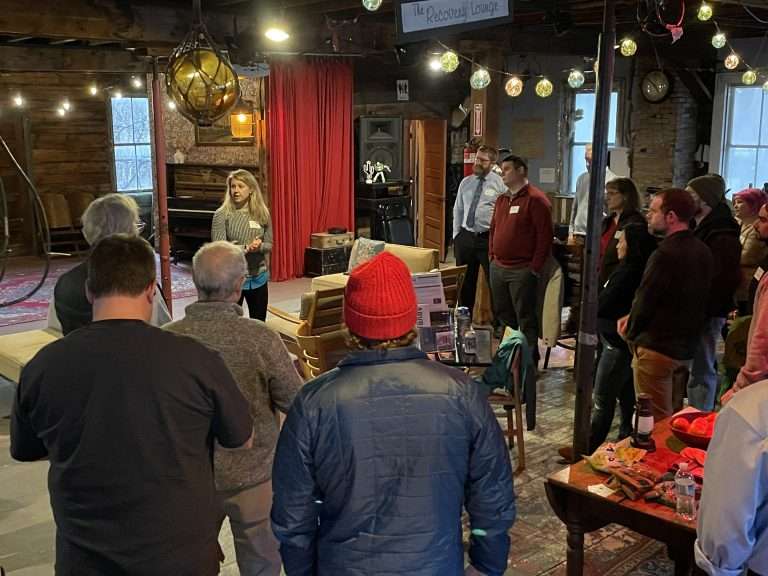
For Schutz, who moved from New York City in 2022, the arts center’s impact extends beyond entertainment. She describes the Recovery Lounge — named for the founders’ upholstery business and the recovered furniture that fills the space — as a “third space” where neighbors connect, musicians form bands, and community members take the stage in theater productions regardless of experience.
“Come consume what we’re making,” Schutz said. “If you can’t give financially but you feel like you can maybe give in time or talent or creativity, reach out to us. We want you here.”
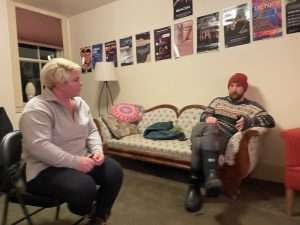
Photo: UJAC Artistic Director Gabrielle Schutz and Board President Chris Radey discuss cuts at the performing arts center.