AU SABLE SCHOOL CLOSURE IS RECOMMENDED
A school consultant recommended Monday evening that Au Sable Forks Elementary School be closed and its 133 students sent to the district’s elementary school in Keeseville, warning that keeping it open would risk bankrupting the district.
Should that happen, the district would go into receivership and be taken over by the state, which would not be bound by existing contracts, policies or citizen preferences.
On the brighter side, Rich Labrie, senior associate for Alliance Education Associates, said one larger school is not only more cost-effective than two small ones, but that the large schools tend to outperform small ones.
Labrie also said the AuSable Valley Central School district might consider building a new wing or school for elementary students at its Clintonville campus, which would involve up-front costs, but be more cost-efficient in the long run. The state, which favors mergers, could potentially support such an initiative financially.
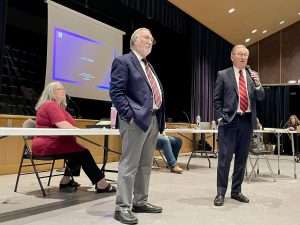
While the board has made no final determination about Au Sable Valley, board members sounded pessimistic that some other option might present itself.
Closure of the school would save a net $1.1 million, Labrie said. Other recommendations of the facilities study — including the transfer of 5th and 6th graders to Clintonville campus — would save an additional $1.7 million. Sixth graders are already being transferred under the 2026-27 budget plan.
About 30 people listened to the consultant’s presentation, and raised concerns about longer bus rides, and mixing younger and older students at Clintonville.
Labrie said the average bus ride to Keeseville would be an additional 10 to 12 minutes, with the longest being an additional 21 minutes. Although Keeseville is losing enrollment faster than Au Sable, the Au Sable school is smaller and would not be able to accommodate both student populations.
As for fifth graders, the consultants said younger students will be well-insulated from older students at Clintonville and that, in their experience, kids are resilient and are better at accepting the change than parents.
Labrie said voters might have bought Au Sable more time had they approved the 12% tax levy override in May, but the proposal was soundly defeated. So “the voters have spoken” about the fate of Au Sable, he said.
Voters did approve a 6% increase in the levy, which was within the tax cap, and that, coupled with budget cuts and the elimination of 21 positions, will buy a little time, said Superintendent Mike Francia. When consultants looked at the numbers last year, they initially projected that, without significant change, the district would be bankrupt in two years.
Board Member Jason Parrow said the district remains in dire condition, and will face a large gap again next year. But the cuts and expenditure of savings that the board relied on this year will not be options in the future. “We’re not going to be missing next year by $100,000; it’s going to be another significant amount,” he said. “There’s nothing substantial left to cut — we are at a loss where to go.”
Going forward, the board will take its message to the public; consultants stressed the need for transparency in what is a difficult time for the community and the board as well.
“I’ve been on board for five years, and I feel like every year we’re looking at places to trim, trim, trim,” said Board President Aubrey Bresett. “Never in a million years did I think we’d be in this position — we have kids in the district as well, and this is what keeps us up at night.”