JAY BEGINS TO DRAFT TOWN RECREATION PLAN
A team of federal, state and regional planners, along with members of a town steering committee, toured Jay on Friday, the first stop in a weekend of meetings intended to produce a community action plan for building an outdoor recreation economy that will serve local residents and businesses.
The visit is part of Recreation Economy for Rural Communities, a program managed by the U.S. Environmental Protection Agency. Jay was one of 25 communities chosen this round from about 200 applicants, according to program manager Steph Bertaina of the EPA.
“Tourists are not the reason that we’re here tonight,” town board member Olivia Dwyer told residents at a public meeting Friday evening. “They’re not the reason we applied, and they are not our priority — you are.”
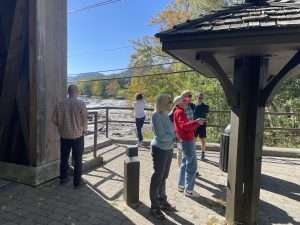 Federal, state and local representatives tour the Jay Covered Bridge Friday.
Dwyer, who chairs the town’s recreation and open space committee, said the town applied in the fall of 2024 after hearing from residents how much outdoor access mattered to their quality of life, and how much they wanted busier hamlet centers with restaurants, shops, galleries and businesses that meet everyday needs. Jay was accepted in fall 2025.
The program is not a cash grant. It provides free planning help from a team of professionals and connects towns with agencies that do have money. Created in 2019, it has worked with about 60 rural communities nationwide, Bertaina said.
Friday’s tour included representatives of federal and state agencies, who will help the town identify funding for projects that come out of the process, Dwyer said. The cost of the weekend’s local events came from occupancy tax revenue, which Essex County collects from lodging guests and distributes to its 18 towns.
Bertaina said the EPA’s interest comes from its mission of protecting human health and the environment. Healthy, walkable communities with strong economies serve both, she said, and a shared community vision can make it easier to win grants.
Joe Fox, recreation manager for the Northern Forest Center, a regional nonprofit based in Concord, N.H., presented national and state figures showing outdoor recreation accounts for more than 2 percent of U.S. economic output. In New York, he said, it supports more than 247,000 jobs and adds $33.9 billion to the state economy. He said the Northern Border Regional Commission has hired SE Group and Headwaters Economics to build tools that will let communities measure outdoor recreation’s impact at the county level.
Residents also heard updates on two projects already underway.
Sarah Duheme said her group is planning a riverside dog park one block from restaurants, shops, a laundromat, the community center and churches. The park would sit on town property but would be paid for entirely through donations and grants, not the town budget. The working fundraising goal is $40,000, with fencing expected in about a year. The group has raised about $3,450 in private donations. It has also secured an in-kind pledge worth $7,440 to build a graded path from the parking area on Grove Road and a year of free waste collection from Pioneer Waste Management. The plans still need formal approval from the town board, which is expected to consider the site plan Oct. 8.
The larger prospect is the Four Peaks parcel, 595 acres at the end of Stonehouse Road that were once the Fourpeaks resort. The state added the land to the Forest Preserve in 2024, making it constitutionally “forever wild.” It borders the Hardy Road mountain bike trails and, through the Three Sisters Preserve, offers a potential woods connection between Jay and Wilmington.
Dwyer said that the land currently has no marked or maintained trails. She said Stonehouse Road is a single-lane dirt road with children and a wheelchair user among its residents, and the clearing at its end is a turnaround for plows and emergency vehicles, not a parking area. Motorized use is prohibited. Despite the name, Rattlesnake Knob is the only summit on the public land.
Patrick Carey, co-chair of the Barkeater Trails Alliance, said the parcel could fill a gap in Jay, where, outside the riverside parks, the main trail is Jay Mountain. “That’s not a walk,” he said. “That’s a hike.”
Carey pointed to BETA’s East Branch Community Trails on the Keene-Jay line, where he said the lot is rarely empty from 7 a.m. until dark and more parking is planned. An initial concept plan for Four Peaks proposes a mix of trails that will serve mountain bikers and hikers and include accessible walking trails.
Carey stressed that the plan is only a starting point and that the trails would be professionally designed and built, with volunteer help. Any proposal would need to go through the state Department of Environmental Conservation’s management plan for the Wilmington Wild Forest. The work would be paid for through state and federal grants rather than town money, and would take years.
“If we do a great job for the community right here, yes, people will want to come visit,” Carey said. “But if we focused on attracting visitors, you’re going to end up with something that doesn’t feel like it’s for you.”
Verification checklist