AVCS BOARD EXPLAINS BUDGET CONCERNS
With enrollment and state aid declining, and property values and insurance costs ascending, the AuSable Valley Central School Board is trying to thread a tight needle to find a combination of tax hikes and budget cuts that community voters will accept, while protecting the district’s reputation for providing students with a quality education.
With revenues and expenses headed in opposite directions, board members told about 75 people at a public meeting Wednesday night that some major structural changes are needed to shore up the AVCS budget for the long run.
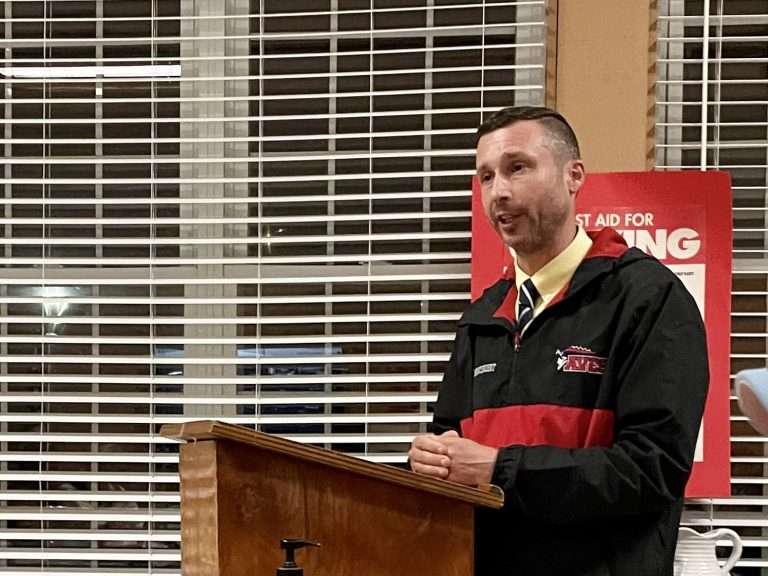
“There is no way for us to cut our way out of this situation, and there’s essentially no way for us to tax our way out of this situation,” said Board Member Jason Parrow. “It’s got to be a joint effort between what we’re willing to lose and what community is willing to contribute. I don’t really know a better way to put it.”
 The budget forum was designed to transparently lay out school finances, but also to take the temperature of the community that will likely be asked to allow the district to break the 2% tax cap, a move that requires approval by 60% of the voters.
Some of the budgetary issues were created years or even decades before, with expenditures and contracts that might have made sense at the time, but have come back to bite. Current retiree health care costs, for example, exceed $5 million annually.
Health care for active workers has also been growing between 5% and 7% a year, and currently cost the school system $13,760 for an individual plan and $35,813 for a family plan. In all, health care costs represent more than one dollar out of every four the district is spending in its 2025-26 budget.
Two covid-era phenomena have also impacted the board’s finances, said Superintendent Mike Francia. One is the end of American Rescue Plan funding that allowed schools to hire teachers to compensate for Covid-era learning loss. Second was an explosion in housing values, along with construction of upscale vacation homes, as buyers came to the Adirondacks to escape the cities.
Those high property values — pushed in many cases by people who do not live here — make the community look wealthier than it really is. So the upshot is that in the eyes of state funding formulae, local residents should be well-off enough to afford to pay a greater share of the school budget.
Also hurting is declining enrollment, which further depresses state funding. So a better than 5% increase in state aid has decreased to the state-minimum 2% increase.
In response to the convergence of the financial issues, the district brought in an expert to analyze the finances and help lay out a permanent fix. It also founded a building committee to assess the district’s facilities.
That could well result in the consolidation of one of the district’s two elementary schools — most likely by closing the school in Au Sable Forks and busing students to Keeseville. Also likely on the block would be the small, administrative office building in Clintonville.
“We all have to wrap our heads around this a little bit and come together over the fact that over the next three years, with the trends that we have and direction that we’re moving, the district is going to look different,” Francia said. “Our goal is to have a sustainable district that we are proud to send our children to — that is my goal, that is the board’s goal, and that’s what we’re working really hard to do under a really difficult situation.”