JAY BOARD EXPRESSES SUPPORT FOR AUSABLE ELEMENTARY
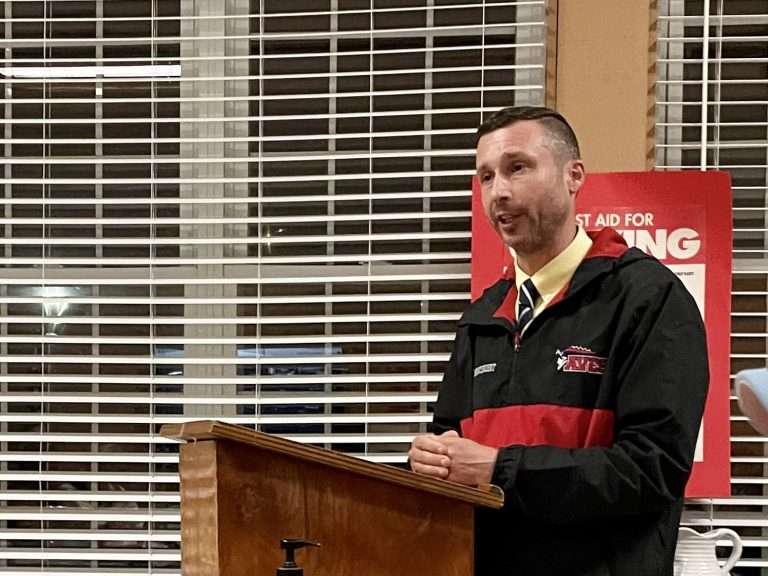
The future of Au Sable Forks Elementary School was “the elephant in the room” Tuesday night as AuSable Valley Central School District Superintendent Mike Francia visited the Jay Town Board to outline a deepening budget crisis that has forced painful staff reductions, prompted discussions about challenging the state tax cap, and placed the district’s facilities under formal review.
Francia, who is working to build community partnerships ahead of a difficult budget season, was candid about the scope of the problem — and the urgency of finding solutions before options narrow further.
“You can’t reduce your way out of it. You can’t tax your way out of it,” Francia told board members. “It’s going to have to be a balance.”
 At the heart of the district’s financial trouble is New York State’s aid formula, which Francia said consistently undervalues the needs of AuSable Valley. The district is projected to receive just a 1% increase in foundation aid next year — roughly $134,000 — a figure that is overwhelmed by rising costs in health insurance, salaries, utilities and general operations.
The formula, Francia said, calculates district wealth partly on the basis of assessed property values. As second homes and short-term rentals have driven up assessments across the Adirondack region, AuSable Valley appears wealthier on paper than it is in reality — a district where many full-time families are of modest means. The result is less state aid than comparable rural districts arguably require.
Compounding the problem is declining enrollment. The district currently counts 1,036 students as of its most recent reporting date, down from roughly 1,200 in recent years. At Au Sable Forks Elementary, Francia said some grade levels now run a single section with dwindling numbers — one section each of kindergarten, first, and potentially second and third grade in the coming year.
To close a budget gap that once projected a $6 million deficit over five years, the district has already made significant reductions. Last year saw seven position cuts; this year, through a combination of attrition, retirements, section consolidations, and the structural shift of sixth grade to the middle school building, approximately 14 positions are being reduced in total.
The sixth-grade move, Francia noted, brings the district in line with neighboring schools and allows middle school credits to be spread across three years rather than two. Planning sessions with teachers, parents and students are underway to ease the transition. Class sizes at both the Keeseville and Au Sable Forks elementary buildings will be pushed toward contractual maximums — 22 students in kindergarten through second grade, 25 in grades three through six.
Francia acknowledged that asking the community to accept those numbers is difficult. “It’s not something we want to do,” he said, “but we can’t afford to run sections of 11 or 12 (students) anymore.”
The question board members returned to most pointedly was whether Au Sable Forks Elementary would remain open. Francia said the building’s fate is not part of the current budget discussion, but is squarely within the scope of a facilities study being conducted by an outside consultant group, results of which are expected in April.
“Everything is on the table,” he said, while emphasizing that no decisions have been made and that data from the study — including transportation modeling, enrollment projections, and building condition assessments — must come first. A community meeting, separate from regular board sessions, is being planned to present the findings and allow public questions.
Board members expressed concern about what consolidation would mean for the town. Supervisor Matt Stanley recalled what happened when AuSable Valley was formed decades ago through the merger of Keeseville and Au Sable Forks. “It essentially killed two main streets,” he said. “The life got sucked right out of those towns.”
Both Francia and the board agreed that the goal remains attracting young families to the region, and that the quality of its schools is central to that effort. “The first thing people look at is housing and schools,” Francia said. “How do we keep our schools a viable option, and how do we also keep our taxes in an area where people can afford to live here?”
For the current budget cycle, the district’s tax levy cap comes in at 5.95% — higher than usual due to debt obligations tied to an ongoing capital project that replaced boilers and roofs at both elementary buildings. Francia said the board is seriously considering going beyond that cap, which would require a 60% supermajority of voters to approve in May.
Projections presented at recent board workshops suggest that a double-digit levy increase may be necessary to provide meaningful long-term financial solutions — though no final number has been set.
Francia urged the town board to help spread accurate information when that campaign begins. “When people hear double-digit percentages, the first thing they do is multiply their tax bill by that,” he said. “That’s not how this works.
The budget vote is scheduled for May. Francia said he will continue to meet with people in the communities to remain transparent as the dialogue continues.